
AHA PALS Provider Certification in Houston
Get American Heart Association PALS Provider training for nurses, paramedics, respiratory therapists, physicians, and healthcare teams who respond to emergencies involving infants and children. Cardiox Care offers AHA PALS classes in the Houston area with official certification cards and easy online booking.
 Trusted by Houston-area students
1,648+ five-star reviews
Trusted by Houston-area students
1,648+ five-star reviews
For pediatric emergency care
- Infant & child emergencies
- Respiratory distress, shock & arrest
- Team-based pediatric response
Is AHA PALS Provider the right class for you?
PALS, BLS, and ACLS are AHA courses built for different patients and requirements. Here is the quick way to tell which one matches what your employer, clinical program, or credentialing office asked for.
Choose AHA PALS Provider if…
Your employer, hospital, clinical program, EMS agency, or credentialing requirement asks for PALS, AHA PALS, PALS Provider, or Pediatric Advanced Life Support.
Choose AHA ACLS instead if…
Your requirement is focused on adult advanced cardiovascular emergencies, adult cardiac arrest, stroke, acute coronary syndromes, or adult critical care response.
Choose AHA BLS first if…
You need healthcare CPR, AED, and ventilation training, or your requirement only says BLS Provider. PALS builds on strong BLS skills and is not a beginner CPR class.
Who needs an AHA PALS Provider class?
AHA PALS Provider is designed for healthcare professionals who respond to emergencies involving infants and children. It is commonly required for clinicians in emergency medicine, pediatric care, intensive care, critical care, EMS, respiratory therapy, and other settings where pediatric patients may need urgent intervention.
Pediatric nurses & hospital staff
PALS is commonly required for nurses and floor staff who care for infants and children in the hospital.
Emergency department clinicians
ED teams often need PALS so they can respond when a pediatric patient arrives in crisis.
ICU, PICU & critical care teams
Critical care and PICU staff are frequently required to hold a current PALS card.
Paramedics & EMS providers
EMS agencies often require PALS for crews who may treat pediatric patients in the field.
Respiratory therapists
RTs who manage pediatric airways and breathing emergencies are commonly asked to keep PALS current.
Physicians & advanced practice providers
Physicians, NPs, and PAs in emergency, pediatric, and critical care roles often need PALS for credentialing.
Urgent care & pediatric clinic staff
Some urgent care and pediatric clinics require clinical staff to hold PALS, depending on their patient mix.
Surgery, PACU & sedation clinicians
Staff in surgery, recovery, and procedural areas may need PALS when pediatric patients are part of their caseload.
Students entering pediatric or emergency roles
Students moving into pediatric, ED, or ICU rotations are frequently required to have PALS before they start.
What AHA PALS Provider covers
PALS is built around recognizing and responding to pediatric emergencies as a team. The focus is on spotting a child who is getting worse, acting early, and working through resuscitation in an organized way. Here are the core areas you work on.
Pediatric assessment
How to quickly size up a sick or injured child using a clear, repeatable assessment approach.
Respiratory distress & failure
How to tell when a child’s breathing is getting worse and when it has become an emergency.
Recognizing shock
How shock can hide early, and how to spot compensated and decompensated shock before a child crashes.
Infant & child CPR foundations
The CPR skills PALS builds on, including the technique differences between infants and older children.
Pediatric cardiac arrest response
How a team works a pediatric arrest in an organized, step-by-step way.
High-quality CPR in resuscitation
Why compression quality matters so much and how to keep it strong throughout a resuscitation.
Team roles & communication
How teams communicate and share clear roles during a pediatric resuscitation.
PALS algorithms
How PALS algorithms guide urgent decisions so the whole team stays on the same plan.
Rhythm recognition
How to recognize the pediatric rhythms that change what the team does next.
Defibrillation & cardioversion
When defibrillation and cardioversion fit into a pediatric emergency, at a concept level.
Airway & ventilation considerations
Key airway and ventilation points for infants and children during an emergency.
Post-resuscitation care concepts
What the team focuses on after circulation returns, to give the child the best chance.
What to expect in class
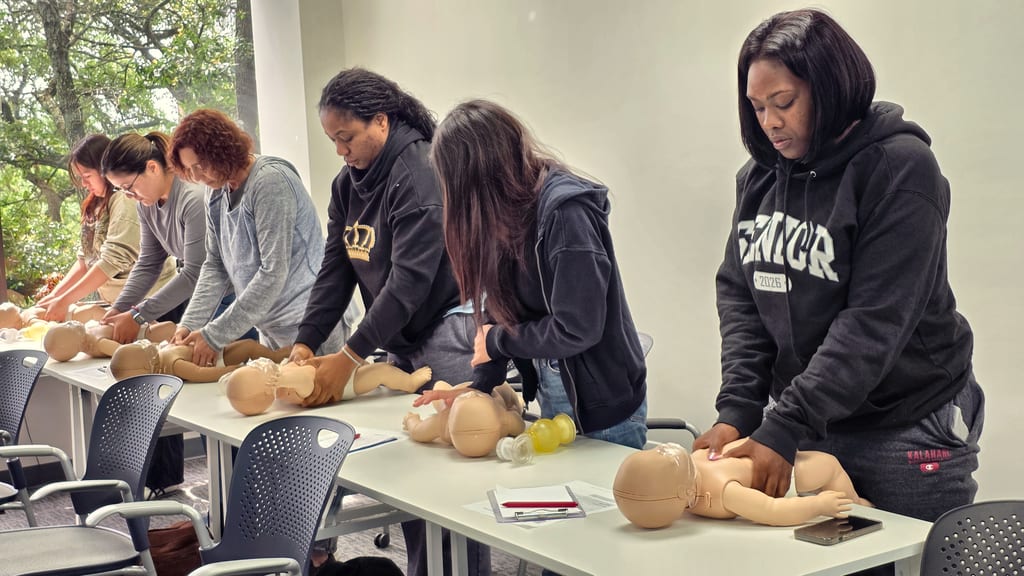
PALS is a scenario-driven class. You work through realistic pediatric cases with a team, apply the algorithms, and complete a hands-on skills check before you finish. Plan to use your BLS skills throughout.
How the class runs
- Instructor-led practice, or a skills session depending on the format you choose
- Pediatric case-based scenarios you work through as a team
- Clear team roles and communication during each case
- Applying PALS algorithms to guide decisions
- Recognizing respiratory, shock, and arrest scenarios as they develop
- Live instructor feedback while you practice
- A hands-on skills check-off before you complete the course
Class length depends on the format you choose. When you book, choose the date and class type that matches your requirement. If your employer or program gave you specific instructions, contact us and we will point you to the right option.
AHA PALS vs AHA BLS vs AHA ACLS
These are three different AHA courses for three different needs. The quick way to choose is to match the course to the patients you care for and the exact wording of your requirement.
- Pediatric advanced life support
- Infant and child emergencies
- Respiratory distress, respiratory failure, shock, and cardiac arrest
- For clinicians who may care for pediatric patients during emergencies
- Builds on strong BLS skills
- Often required for pediatric, emergency, ICU, EMS, and critical care roles
- Healthcare CPR foundation
- Adult, child, and infant CPR
- AED and basic ventilation skills
- Usually required before or alongside PALS
- Better for students or staff whose requirement only says BLS Provider
- Adult advanced cardiovascular emergencies
- Adult cardiac arrest, stroke, ACS, dysrhythmias, and post-arrest care
- Better for clinicians whose role focuses on adult emergency or critical care response
If your requirement says PALS, AHA PALS, or Pediatric Advanced Life Support, choose AHA PALS Provider. If it only says BLS, choose AHA BLS Provider. If your requirement is for adult advanced cardiovascular emergencies, AHA ACLS may be the better advanced course.
AHA PALS certification card details
After you complete the course and pass the skills check, you receive an official AHA PALS Provider course completion card. Here is what to know about it before you book.
- Official AHA PALS Provider cardYou receive an official AHA PALS Provider course completion card (eCard) after successfully finishing the class and skills check.
- Generally valid for two yearsAHA PALS Provider course completion cards are generally valid for two years. Many clinicians renew before the expiration date so there is no gap.
- Check your specific requirementEmployers and schools may require a specific certifying provider. Check the exact wording of your requirement before booking.
- Continuing education creditCE credit can depend on the course option and your profession. If CE matters for your role, check the provider and course details before you enroll.
- Not sure which option you need?Contact Cardiox Care and we will help you confirm the right AHA PALS option before you enroll.
AHA PALS classes near Houston
Cardiox Care offers AHA PALS Provider classes across the Houston area so clinicians can choose the campus that works best for their schedule, commute, and workplace requirements.
North Houston
Convenient for north-side hospitals, EMS crews, and clinical staff.
Southwest Houston
Central for southwest-area clinics, hospitals, and healthcare teams.
Katy
Easy for west-side clinicians and students balancing work and school.
Galveston
Serving island and south-county hospitals and pediatric programs.
Why take AHA PALS with Cardiox Care?
We keep PALS scenario-driven and led by instructors with real clinical experience, so you leave ready to work a pediatric emergency as part of a team, with the AHA card your role requires.
Hands-on, practice-focused training
Most of class is spent working scenarios and skills, not sitting through slides.
Instructor feedback in real time
Certified instructors correct your technique and decisions as you practice.
Pediatric emergency scenarios
Realistic infant and child cases so the response feels familiar when it counts.
Team-based practice
Practice clear roles and communication the way a real resuscitation team works.
Official AHA completion cards
An official AHA PALS Provider card after you pass the skills check, where applicable.
Same-day eCards where applicable
eCards issued quickly after successful completion, where applicable.
Clean, comfortable classrooms
Well-kept rooms and equipment for a focused, comfortable class.
Houston-area locations
North Houston, Southwest Houston, Katy, and Galveston.
Easy online booking
Choose your class, location, and date online in a few steps.
AHA PALS Provider FAQ
Common questions from nurses, paramedics, and healthcare teams. Still unsure which class you need? Send us your requirement and we will help.
Ready to book your AHA PALS Provider class?
Choose a Houston-area AHA PALS class date, confirm the provider your employer or program requires, and reserve your seat online.
Call or text 281-524-2767